AttackMap
Local-first, AI-assisted defensive security analysis for codebases.
Looking for help beta
AttackMap reads a repository — or a whole fleet of them — the way an attacker would. It reconstructs the attack surface (routes, data stores, external calls, auth signals, trust boundaries), traces request-to-sink data flow, scores exploitability, and writes an evidence-grounded, prioritized security review. It finds the cross-cutting weaknesses single-file scanners miss.
Everything runs on your machine. Nothing is uploaded unless you explicitly turn on an LLM backend, and the output is aimed entirely at remediation: no exploit code, no offensive payloads.
What it finds
Attack-surface recon
file:line citation, an evidence snippet, and a confidence level.Data-flow and injection taint
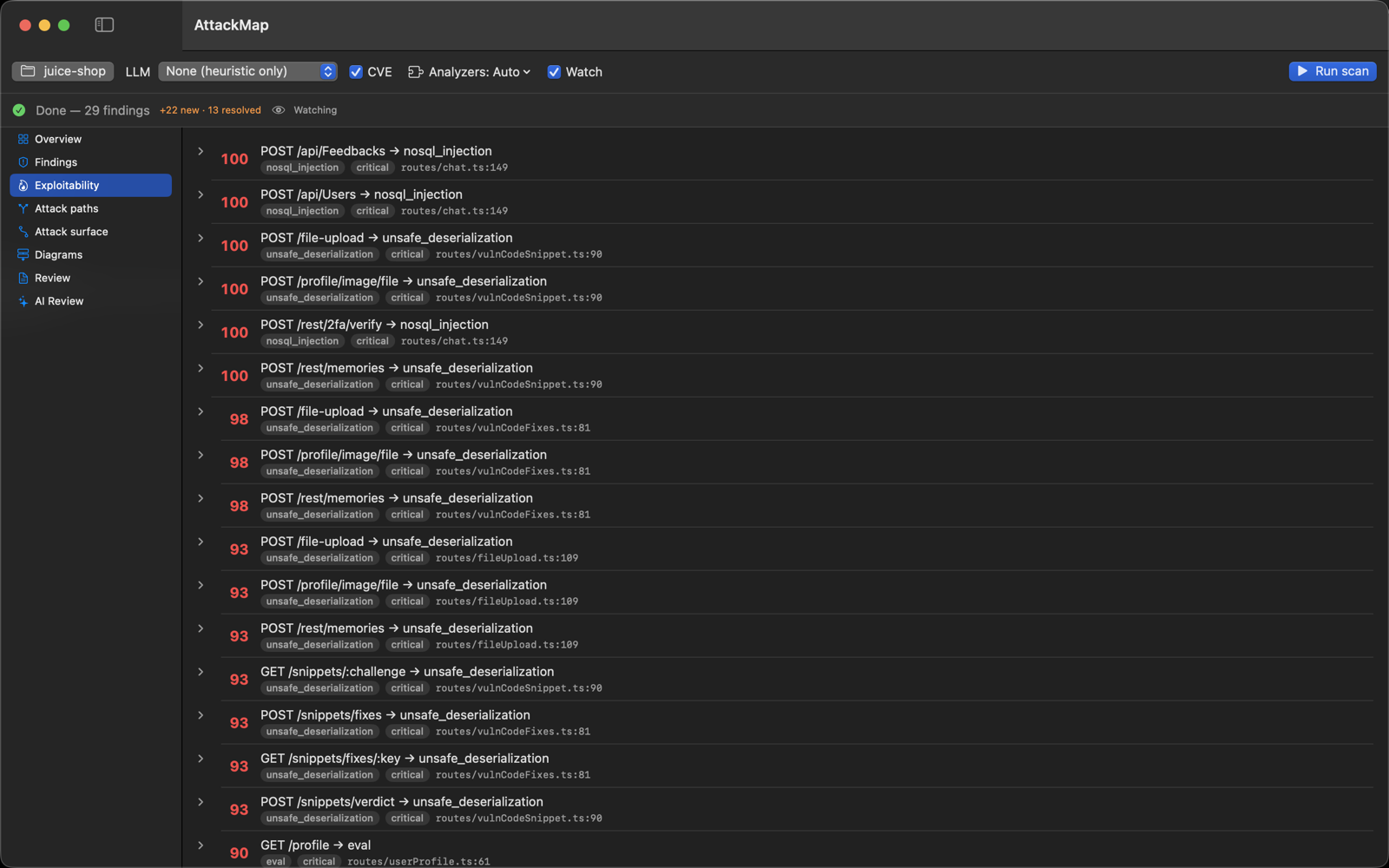
Exploitability scoring
Beyond the taint families
Anomaly and invariant mining
Dependency CVEs
--cve builds an SBOM, resolves lockfiles, and cross-references OSV.dev, folding known-vulnerable packages into the exploitability ranking.AI review and a verify jury
--llm writes a narrative defensive review with Claude or OpenAI. --hunt --verify proposes evidence-cited exploit-chain hypotheses and adjudicates each against the cited source, scaling into a majority-vote jury.Cross-repo fleet analysis
attackmap analyze repoA repoB … links one service’s outbound calls to another’s routes and surfaces the bugs in the seams: confused-deputy flows, trust-assumption gaps, and the sibling that omits a control its peers enforce.Built for CI
--fail-on-new-high, --triage, --remediate, finding suppression, and a GitHub Action with a PR bot.Get started
AttackMap needs Python 3.11 or later and installs straight from GitHub:
pipx install git+https://github.com/mlaify/AttackMap.git
Or install the core plus every official analyzer plugin, and run your first scan:
pip install "attackmap[all] @ git+https://github.com/mlaify/AttackMap.git"
attackmap analyze /path/to/repo --output reports
A few common runs:
attackmap analyze <path> --cve            # dependency CVEs (OSV.dev)
attackmap analyze <path> --llm            # AI narrative (--llm-provider claude|openai)
attackmap analyze <path> --hunt --verify  # exploit-hypothesis hunt, adjudicated against source
attackmap analyze <path> --baseline prev.json --fail-on-new-high   # PR gate
attackmap analyze ./svc-a ./svc-b ./gw    # cross-repo fleet scan
attackmap suggest ./repo                  # recommend analyzer plugins
Start with reports/defensive-review.md. Every run also writes JSON
(attackmap-report.json), SARIF, and diagram artifacts. The
quickstart, CLI reference,
and outputs reference cover the rest.
Supported ecosystems
Fourteen analyzer plugins, each installable on its own ([all] installs every one):
Python, JavaScript/TypeScript (Node services), Go, Java/Kotlin
(Spring), C# (ASP.NET Core), Rust, PHP (web, Laminas, Omeka-S), C,
C++, Terraform, IaC (Docker, Compose, GitHub Actions), and the
AT Protocol. A Swift analyzer is an early scaffold. To cover something else, write
your own against the analyzer SDK.
The macOS app
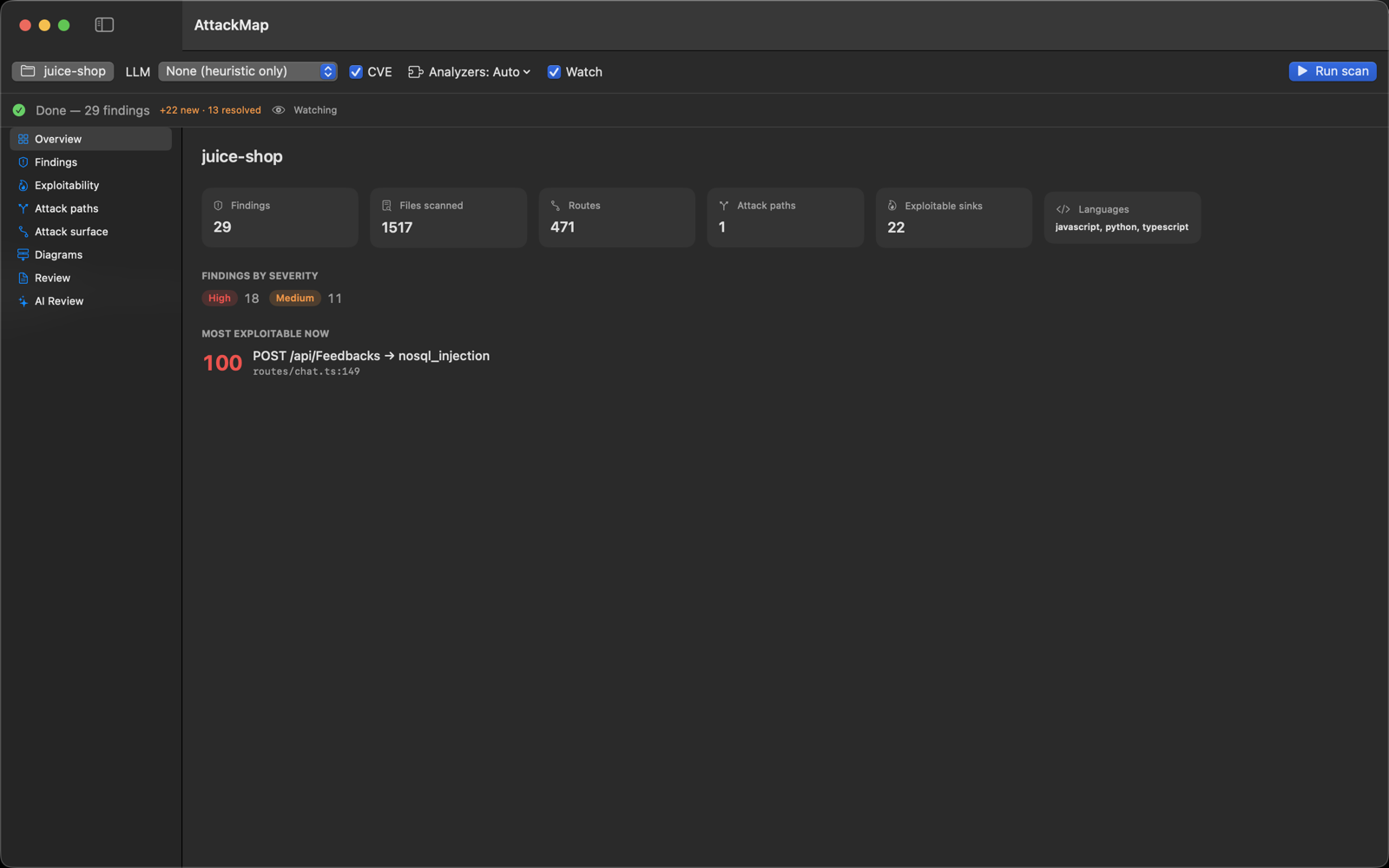
A native macOS front end drives the same CLI and renders every result view — overview, findings, exploitability, attack surface, attack-path diagrams, and the review — with watch mode and fleet scans. Build it from source at mlaify/AttackMap-mac; the macOS app guide walks through it.
What AttackMap is not
- Not a runtime detector. It’s static analysis; its detection hints are leads for your SIEM team, not deployable rules.
- Not a replacement for dedicated SCA.
--cvefolds CVE signal into an architecture-aware narrative; Trivy, Grype, and Dependabot go deeper on resolution. - Not a sound taint engine. The data-flow pass is a call-graph-refined import-graph walk that favors precision over recall. Findings are evidence, not proof.
- Not exhaustive. It’s heuristic by design, with explicit confidence tiers. Treat it as a strong lead generator and reviewer aid, not a substitute for manual review.
Links
- docs.mlaify.io — install, quickstart, CLI, AI review, CI, the macOS app, and the SDK
- mlaify/AttackMap — the core engine (MIT)
- Analyzer plugins — one repo per ecosystem
- mlaify/AttackMap-mac — the macOS app
- Road to 1.0 · Contributing · Security policy